How the Social Media Economy Shapes Young People’s Politics
Social media polarisation is not accidental. It is economically incentivised. And although it feels almost insulting to previous generations, who were subject to their own forms of media distortion and historical revisionism, the scale of what exists now is different. The commodification of political identity - and the sheer volume and accessibility of polarising content - is a danger we are only beginning to understand the ramifications of. What outcome other than division can realistically be expected when platforms profit from emotional intensity? TikTok does not really care whether you leave the app politically informed or psychologically exhausted, provided you remain scrolling long enough to serve another advert.
Politics online increasingly feels less like democratic participation and more like performance art. You are rewarded not for accuracy, nuance or truthfulness, but engagement. A 2021 internal Facebook study leaked to the Wall Street Journal found that posts provoking anger consistently performed better because they generated more interaction. Outrage has effectively become the reserve currency of the modern internet.
And while every generation likes to believe the next has been uniquely corrupted by media, there is something genuinely different about an ecosystem in which billions of people consume algorithmically personalised political content every single day. TikTok alone has more than 1.5 billion users worldwide, while YouTube users collectively watch over a billion hours of content daily. None of this material is filtered by public interest first. It is filtered by systems designed to keep people watching for as long as possible.
According to Ofcom, adults in the UK now spend an average of four and a half hours online daily, with younger adults spending significantly longer. Increasingly, social media is not simply where young people socialise; it is where they learn, argue, form political identities and understand the world around them.
That would realistically be less concerning if these platforms functioned like public forums. They do not. They are advertising businesses.
“Social media is essentially a commercial environment,” explains Dr Debbie Ball, Data and Society Lecturer and PhD doctoral researcher at the University of Westminster. “No matter how much the platforms encourage us to believe they’re connecting the world or creating community, it’s still basically fair game for anyone with a lot of ad spend to promote their content up the algorithm.”
This is the contradiction at the centre of modern online political discourse. Platforms market themselves, and are often perceived, as tools for expression while really they are closer to behavioural extraction systems. Every click, pause, rage-comment and doomscroll becomes commercially valuable data used to retain people’s attention.
And attention, unfortunately for civilisation, is most easily captured through emotional stimulation rather than measured analysis of material conditions.
A detailed explanation of housing inequality may reach a few thousand people. Meanwhile, a man in a Nike dry-fit set and sunglasses shouting about “the collapse of masculinity” from inside a leased BMW can reach millions. Before being banned from several platforms, Andrew Tate content amassed billions of views across TikTok through reposted clips built almost entirely around outrage and provocation. However, it is important to make clear that although people’s underlying biases deserve some culpability, these systems are specifically designed to reaffirm those biases and keep users hooked. People are not necessarily becoming inherently more extreme. Rather, the systems distributing information reward emotionally provocative material above almost everything else.
Carl Miller, author, speaker and researcher at Demos, describes these systems as “attention optimisation algorithms”, arguing they may be “the most important single piece of technology affecting culture” today.
“The problem is that the very basic design decisions the platforms have made have all been made to protect their user base as much as possible,” Miller says. “Whatever keeps you on the platform is what they need to serve to you.” And that pursuit of retention has profound political consequences.
Social media companies often reject accusations that they intentionally radicalise users, and both Ball and Miller are careful not to suggest some grand conspiracy in which Silicon Valley executives sit in darkened rooms plotting ideological manipulation. The reality is arguably more disturbing because it is more banal. Platforms do not necessarily care what ideology succeeds; they care what keeps people engaged.
Miller notes that algorithms appear to appeal to “primordial psychologies”, emotions such as anger, fear, humour and validation. Content provoking strong emotional reactions keeps users interacting with the platform longer, generating more advertising revenue in the process.
Most people understand this at a basic level, but maybe not how quickly this creates an environment where political creators are incentivised toward absolutism and provocation. Just look at the shift of so many online political commentators during the social media age: Candace Owens, Dave Ruben, Tim Pool. Whether people agree with them or not, their growth coincided with a media environment that heavily rewards reaction, conflict and certainty. It is unsurprising these individuals moved to the side of the political spectrum that is underpinned by the same reaction politics that is rewarded.
You only need to spend five minutes on political TikTok to see this functioning in real time. Immigration panic, “red pill” masculinity influencers, culture war outrage, anti-vaccine conspiracies and misinformation all coexist beside cat videos and makeup tutorials in one endless personalised stream of monetised stimulation.
And while personal agency matters too, and older generations often dismiss this as young people being “too online”, the consequences are tangible.
The rise of misogynistic influencer culture around figures like Andrew Tate demonstrated how rapidly algorithmic systems can funnel vulnerable young men toward reactionary content. Research by the Centre for Countering Digital Hate found that TikTok accounts registered as teenage boys were recommended misogynistic content within minutes of opening the app. A teenager watching gym videos can quickly find himself consuming pseudo-political content about feminism destroying civilisation before the algorithm eventually recommends a man explaining why women should not vote.
The issue, as Dr Ball argues, is not that social media platforms were originally designed with the explicit purpose of causing harm. Rather, they were designed quickly, scaled aggressively and regulated retrospectively.
“There’s this retrofix culture,” she explains. “They create a new product and don’t particularly test how it affects people thoroughly enough, so they fix the problems retrospectively.”
The consequences of that “retrofix culture” became globally apparent during the Cambridge Analytica data scandal. Listen to Facebook CEO at the time Mark Zuckerberg speaking to American congress. https://www.youtube.com/watch?v=mGpPHZB_fvI
The scandal centred around a Facebook-linked personality quiz app called “This Is Your Digital Life”, which harvested data from millions of users - and, crucially, their friends - without meaningful consent. That data was then reportedly used to build psychographic profiles capable of microtargeting political messaging during the Brexit referendum and Donald Trump’s 2016 presidential campaign. The scale was staggering. Data from up to 87 million Facebook users was improperly accessed.
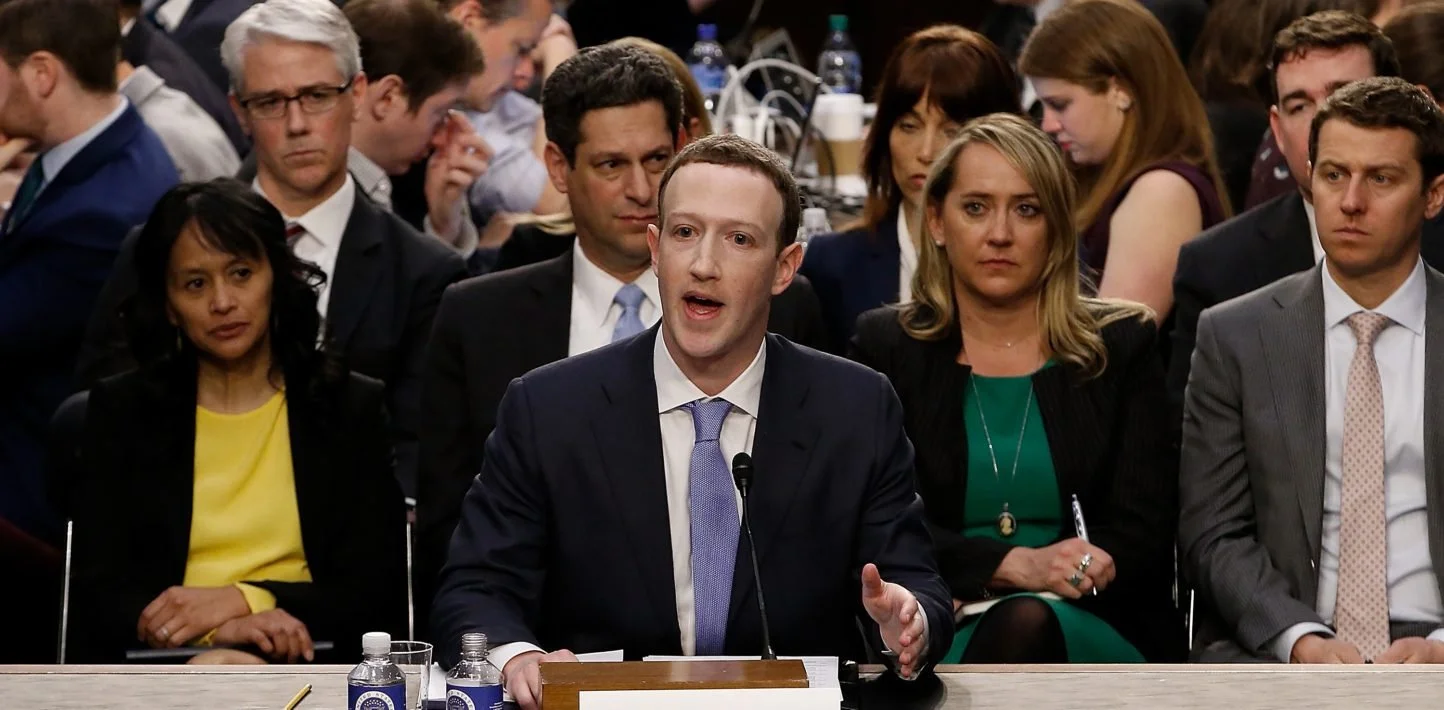
Meta CEO speaking to American Congress after Cambridge Analytica scandal
What made Cambridge Analytica particularly alarming was not simply the data harvesting itself, but what it revealed about the structure of modern political communication. Political persuasion had become hyper-personalised, basically invisible and algorithmically distributed. As is generally the way with such scandals, despite public outrage, little fundamentally changed.
Tech companies absorbed fines worth billions while continuing to generate vastly larger profits. In 2023 alone, Meta generated over $130 billion in revenue globally. Ball notes that many critics now argue these penalties are effectively “built into the business model”.
The problem, she argues, is that platforms are still largely shielded from liability for the content they host and amplify. Under legislation dating back to the early internet era, specifically Section 230 of the Communications Decency Act of 1996, social media companies are treated more or less like neutral publishers.
As a result, platforms can often avoid responsibility by framing harmful content as simply the product of user behaviour rather than algorithmic amplification.
“They’re blaming the users and not taking responsibility for the way the content is propagated through the platform,” Dr Ball says.
This raises a larger question. Who benefits from a political environment dominated by emotionally reactive discourse?
One of the clearest features of online political culture is how effectively structural issues disappear beneath endless culture war propaganda. Discussions around wealth inequality, labour exploitation or corporate power rarely trend with the same intensity as inflammatory debates around identity, immigration or manufactured outrage. In 2024, Oxfam reported that the world’s richest 1% accumulated more wealth than nearly two-thirds of humanity combined since 2020, yet online political discourse often focuses far more heavily on symbolic cultural conflict than economic inequality.
This is not accidental either. Structural analysis is difficult and it requires context, patience and sustained attention, precisely the things social media platforms erode. Rage-bait, on the other hand, is immediate and profitable.
To be clear, misinformation and propagandistic media long predate social media. Miller is careful to stress that society did not exist in some perfectly rational information utopia before the internet arrived.
“There’s always been commercial interests in broadcast and print,” he explains. “Journalism has always been a commercial pursuit itself.”
But social media accelerates and personalises these dynamics at an unprecedented scale. Billions of pieces of content are filtered into highly individualised feeds which are shaped by behavioural data and engagement prediction systems.
This can be particularly dangerous for younger audiences still forming political identities.
“Molly vs the Machines” is a documentary film exploring the tragic death of 14-year-old Molly Russell, who took her own life in 2017 after being exposed to harmful content on social media. The case exposed the devastating consequences recommendation systems can have when harmful content is repeatedly pushed through algorithms without proper checks. Although centred on mental health rather than political radicalisation, it highlighted the same underlying issue. Platforms optimise for engagement first and deal with social consequences later.

Molly vs the Machines - Channel 4
Research continues to suggest younger users are especially vulnerable to harmful recommendation systems. A 2023 report from Amnesty International found TikTok’s algorithm was capable of rapidly pushing vulnerable teenagers toward harmful mental health content based on minimal engagement signals. Still, neither Ball nor Miller believes the solution is as straightforward as censorship.
Ball supports stronger regulation and potentially banning social media for under-16s, but remains sceptical about simplistic solutions. “Banning it will not necessarily solve the problem,” she says. “It needs to be reformed in the way it’s designed.”
Miller similarly argues that understanding online behaviour requires acknowledging fundamental aspects of human psychology. People are naturally drawn toward information confirming their worldview.
“We try a lot harder to prove ourselves right than prove ourselves wrong,” he says.
Social media algorithms exploit this tendency perfectly. They learn what users emotionally respond to and feed them increasingly similar material, so confirmation itself becomes addictive.
The irony, then, is that platforms often marketed as tools for connection may instead be worsening societal fragmentation. Political identity online increasingly resembles fandom culture: aesthetic, performative and hostile to dissent. And somewhere inside this endless churn of discourse, ads are being sold and companies are seeing profit.
That may ultimately be the bleakest reality of all. The polarisation of young people is not just a cultural phenomenon or technological accident. It is also economically useful.
One of the strangest parts of growing up alongside social media has been watching people I knew drift politically in real time. Friends who, a few years earlier, cared more about football or nights out than immigration statistics suddenly started repeating algorithmic slogans about “invasions” and “Britain being lost.” And honestly, it would be naive to pretend some of those attitudes appeared from nowhere. Were some already susceptible to those narratives? Probably. I suppose prejudice rarely materialises in a vacuum.
But that is precisely the danger of engagement-driven platforms. Social media does not create every harmful belief from scratch. It identifies existing anxieties, frustrations or biases and relentlessly feeds users content intensifying them because outrage keeps people scrolling. The stories spreading furthest are rarely the most nuanced or representative. They are the ones most capable of provoking reaction. So, ask yourself. If emotional content that garner's reaction is the currency online, and we live in a world where wealth is nauseatingly put at the summit of all that is worthwhile, what kind of political culture do we risk tottering into?