Scotland’s Culture War Is Escalating - Because the Left Keeps Playing Defence
There’s something unsettling about watching fringe figures make bold claims under the banner of “debate” while Scotland’s progressive politics flounder on courtesy and caution. What was once dismissed as caricatured culture-war theatrics in Westminster and the murky corners of social media has spilled across the UK border, and Scotland’s left is still trying to respond with good manners and policy papers.
The latest flash point wasn’t in Holyrood or Westminster, it was at Abertay University in Dundee. A senior lecturer invited Marsha Sturgeon, operations director of Justice for Innocent Men Scotland (JIMS), to speak to criminology students about so-called “miscarriages of justice” in rape cases. The group’s website and social media have been criticised for targeting survivors and trivialising sexual violence, Sturgeon even posted online mocking two women survivors for lacking a “victim vibe”. In response to the backlash, the university confirmed the talk had not been approved by senior management and launched a review of external speaker policies, emphasising that these views “do not reflect those of Abertay University.”
Outrage was swift from students, survivor advocacy groups and politicians, culminating in counter-lectures organised by Dundee Women’s Aid and others, as well as graffiti on campus branding the lecturer a “rapist sympathiser”.
The incident reveals more than a campus free-speech row, it shows how cultural controversy is weaponised in contemporary politics. Right-wing groups frame such debates as an attack on free inquiry, while progressives default to bureaucratic responses that rarely resonate beyond Twitter threads. In a theatre of grievance, procedure loses to spectacle – and as if the left couldn’t make a spectacle of the right. Matthew Goodwin, Nigel Farage, take your pick.
This dynamic isn’t confined to universities. Scotland’s broader political landscape shows right-aligned parties and populist movements gaining traction while the left struggles to articulate a compelling, offensive narrative. In the Hamilton, Larkhall and Stonehouse by-election, Reform UK surged to 26.1% of the vote, closing in on both Labour and the SNP and signalling an appetite for alternatives to traditional party politics. Meanwhile, support for Reform in Scotland, a party once marginal north of the border, has climbed into double digits in recent polls, peaking around 18% in Holyrood voting intention, outpacing Labour and Conservatives on some measures.
Alongside electoral shifts, public sentiment on cultural questions is hardening. A recent Norstat poll found that over half of Scottish voters favour tougher immigration controls, up from previous years, a trend driven by voters across age and class groups.
Yet what makes these trends striking isn’t just the numbers — it’s how political leaders and commentators react. Take John Swinney’s trenchant critique of his own party’s shifting stance. At a recent SNP conference, he described both Labour and the Conservatives as being locked in “a race to the right”, cautioning that failure to counter Reform UK’s messaging simply hands the battlefield to their opponents.
Meanwhile, at the 2025 Scottish Labour conference, Sir Keir Starmer issued a rallying rhetoric against the SNP’s record on public services and governance, promising to deliver “a Scottish answer” to working-family woes, but stopped short of directly naming the broader cultural challenge posed by populist movements.
There’s a pattern here: on matters where cultural narratives dominate - immigration, identity, safety, justice - the left often falls back on procedural language (policy reviews, consultations) or vague appeals to inclusivity. These are noble aims, but they don’t shape narratives in the way that visceral stories of belonging, threat and agency do. While some on the left warn of “weakening institutions” or advocate cautious coalition-building, truly this amounts to defensiveness and an unwillingness to meet cultural conflicts on their own terms.
This is not merely a media or personal complaint. Even prominent left-wing voices argue like Ash Sarkar argue that the left’s reluctance to engage in cultural conflict leaves it on the back foot: successful movements often swim toward controversy, not away from it, using identity and conflict to build broader appeal rather than retreating to consensus and compromise.
What’s missing in Scotland is a positive offensive narrative that speaks to both economic and cultural anxieties. Working people who feel left behind by cost-of-living pressures, housing challenges and public-service strains aren’t necessarily buying into extremist rhetoric, but they are buying the stories that explain why they feel ignored. If the left only answers questions it prefers (funding childcare, building GP capacity) without addressing fears about community, identity, and fairness, it leaves a vacuum that others are all too happy to fill.
The far-right or culture-war fringe will continue to exploit that vacuum. They’ve mastered optics and grievance, and for every press release from a progressive spokesperson, there’s a viral meme from the opposition calling the left out for weakness or hypocrisy.
If Scotland’s left wants to shift the narrative - not just win elections but shape the civic conversation - it must move beyond defensive posture. That means offering a coherent, values-driven project that speaks directly to the experiences of voters: protecting rights and security, advocating fairness and belonging, confronting injustice without forfeiting moral clarity.
You can’t out-storyteller a populist by reciting cost-benefit analyses. In a culture war, narrative precedes policy, Scotland’s rightward drift won’t be checked by proceduralism alone.
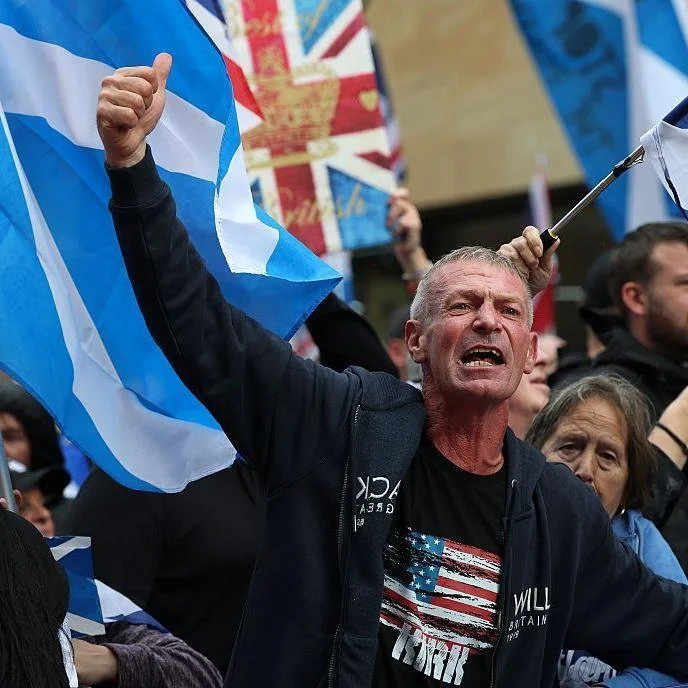
Right-wing march - Scotland