Impartiality or control? Who decides what free speech looks like in UK media
The BBC insists impartiality is the foundation of public broadcasting. However, critics increasingly argue that impartiality has become a softer word for caution, particularly when speech threatens political or institutional comfort.
That tension exploded publicly during the BAFTAs controversy. During the live broadcast, chants of “Free Palestine” were reportedly removed from BBC coverage, while John Davidson’s Tourette’s tic - which included racist language - remained audible. Put aside the quite frankly insane reaction from black Americans, which I believe and hope to be representative of the reactionary Trumpian society Americans are subject to.
For many younger viewers online, the contradiction looked impossible to ignore. Political speech was edited out while offensive language stayed in meaning this was a choice. https://www.youtube.com/watch?v=hGBYWA4whHQ
The BBC never framed the decision as censorship. But to audiences already suspicious of mainstream media, it reinforced a growing belief that some forms of speech are treated as more dangerous than others. And how that is determined can only be assessed from the outside by looking at who tends to be the most effected. Well, I’m yet to see, and highly doubt we ever would see someone’s speech cut for a pro-isreal stance.
The question raised by the BAFTAs controversy is not simply whether the BBC made the correct editorial decision, but whether political speech in Britain is increasingly moderated according to institutional comfort rather than a clear and consistent principle.
That question sits at the centre of a much larger crisis facing British media: who decides what speech is acceptable, and whose interests those decisions ultimately protect.
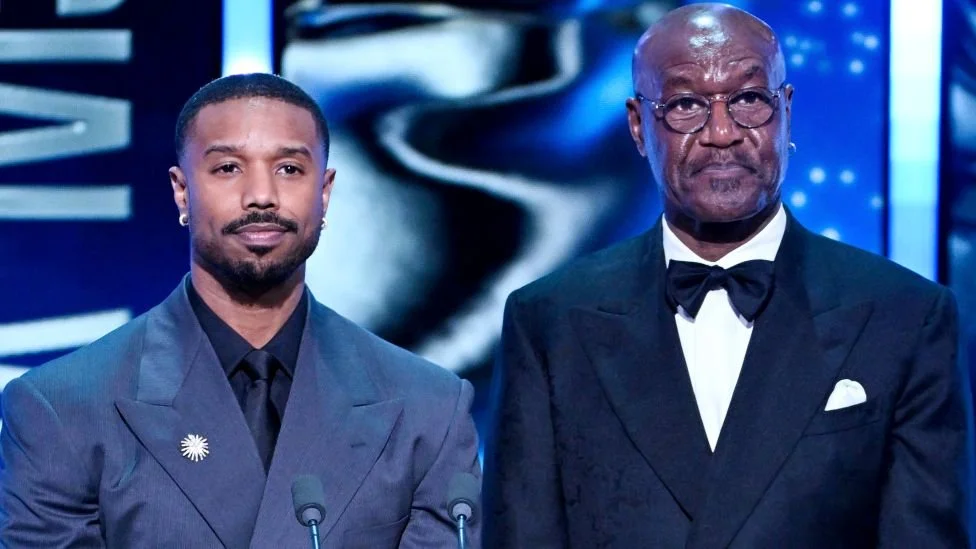
Michael B. Jordan and Delroy Lindo presenting at 2026 BAFTAs
Claire Enders CBE, founder of Enders Analysis and one of Britain’s most influential media analysts, argued that most editorial decisions inside the BBC are not ideological conspiracies but complex institutional calculations.
“At the heart of it all is this mysterious element called impartiality,” she told me. “It’s very hard to understand, except it’s enshrined in the charter.”
That word “impartiality” appears constantly throughout the BBC’s editorial structure. I probably heard it 5 times a day while interning as a sportswriter for BBC Scotland. Under Ofcom’s Broadcasting Code, broadcasters are legally required to preserve “due impartiality” on politically controversial issues. Importantly, Ofcom makes clear that “due impartiality” does not mean giving every opinion equal airtime. Instead, coverage must be “adequate or appropriate” depending on context. That wording matters because it leaves significant room for editorial interpretation.
Enders argued that the BAFTAs situation reflected exactly that kind of judgement call.
“They decided that someone with Tourette’s syndrome should not be deprived of his voice,” she said. “Whereas ‘Free Palestine’ is a political stance that many people take.”
But with young people, who are so aware of political and foreign conflict because of the nature of social media, it's extremely hard to convince them that free Palestine is any more political than saying don't shoot as someone points a gun at an innocent bystander. And rightfully so. It’s about human rights not complex politics.
She also argued the phrase had become politically explosive in Britain following rising tensions around anti-Semitism allegations.
“It’s become a lightning rod for anti-Semitic events,” she said. “So these things should be kept a lid on.”
That quote reveals something important about modern broadcasting. The chant was not removed because it was illegal. It was removed because executives believed it carried political consequences. That distinction is central to the entire debate.
Former BBC journalist Barnie Choudry, who worked for the broadcaster for 24 years, pushed back strongly against the idea that broadcasters are directly controlled by governments or intelligence services.
“I don’t think it’s conspiracy,” he told me. “I genuinely think it was cock up.”
Choudry argued many controversial decisions are the result of poor staffing, collapsing newsroom structures and institutional panic rather than deliberate political agendas.
“The BBC are not employing the right people,” he said. “They are letting people with experience go, and they’re not training them properly.”
But Choudry feels the BBC now operates in an impossible environment.
“We’ve got to make sure that we’re fair, balanced, accurate and impartial,” he explained. “What we mustn’t show is our political leaning.”
But that idea of “not showing a political leaning” is getting harder and harder to actually sustain in practice. Because neutrality doesn’t really sit outside of politics anymore. Every editorial decision, what gets cut, what stays in, what gets framed as acceptable or not, is already political in how it ends up being received.
Cut a chant and people call it censorship. Leave it in and people accuse the broadcaster of activism. But there’s a third reading that often gets missed: even silence can be political, especially when it’s applied inconsistently. From that angle, the BBC isn’t just being misunderstood or navigating precarious waters, it’s operating in a space where neutrality is no longer seen as the absence of politics, but as a position within it. And once you accept that, “pure impartiality” stops looking like a fixed standard and starts looking more like a constant argument over who gets to be heard, and who doesn’t.
The collapse in trust among younger audiences did not happen overnight.
Research from Ofcom and the government’s BBC Mid-Term Review found that impartiality is consistently one of the lowest-rated aspects of BBC news coverage.
One Ofcom-linked survey found BBC News ranked below Channel 5 and Sky News for perceived impartiality among audiences. That decline has coincided with the explosion of TikTok, YouTube commentary channels and politically driven online media like Novara Media, Owen Jones and Hasan Piker, where opinion is presented openly rather than hidden behind institutional language.
Choudry believes broadcasters fundamentally failed to adapt to that shift.
“Nobody watches appointment-to-watch television anymore,” he said. “Young kids are getting their news from social media from people they trust because they think they’re more reliable than the BBC.”
He argued mainstream broadcasters still communicate like it is 2005 while younger audiences consume politics entirely differently.
“You’ve only got three seconds to persuade them to watch and listen to you,” he said.
That matters because social media has completely changed how people interpret institutional authority and how they consume news. Younger audiences no longer assume the BBC is automatically trustworthy simply because it is the BBC.
Instead, they compare clips, reactions and narratives across dozens of platforms instantly. And when editorial decisions appear inconsistent or influenced they create their own explanations.
The BBC and Ofcom consistently defend impartiality rules as protections against political bias. But critics increasingly argue those same rules can become tools for suppressing controversial speech.
Ofcom states that broadcasters must avoid giving “undue prominence” to political opinions and maintain “due impartiality” on controversial public issues.
In theory, those rules sound reasonable.
In practice, they create difficult questions: Is “Free Palestine” a humanitarian slogan or a political statement? Is refusing to air it impartiality or suppression? Why are some forms of nationalism framed as democratic debate while others are framed as risks to public order? Who actually decides where that line sits?
These are not abstract questions anymore.
Since October 2023, journalists, football pundits, musicians and actors across the UK have faced backlash, suspensions or investigations over pro-Palestinian speech.
Gary Lineker was temporarily removed from Match of the Day after criticising government asylum rhetoric online. Ofcom later suggested freedom of expression also had to be weighed alongside impartiality rules.
GB News, meanwhile, has repeatedly faced accusations of breaching impartiality regulations while simultaneously being defended by politicians as offering “balance”.
That inconsistency is exactly what fuels public suspicion. Because if impartiality rules are applied differently depending on politics, audiences stop believing they are neutral standards at all.
One of the most revealing moments in my interview with Enders came when discussing how editorial decisions are made internally.
“They will be guided by the government, by the head of Ofcom,” she admitted.
Not controlled. Guided.
Think about it, that distinction matters.
Modern political influence rarely works through direct censorship. It works through pressure, anticipation and institutional fear. Broadcasters know which stories generate ministerial outrage, newspaper attacks and accusations of extremism.
Over time, caution becomes embedded into editorial culture itself. The result is a form of self-regulation shaped by political atmosphere. And nowhere is that more obvious than around Palestine.
Even outside the BBC, major institutions increasingly treat pro-Palestinian speech as uniquely volatile territory. Universities have restricted protests. Employers have investigated staff social media posts and protest laws have expanded dramatically under recent governments. I mean Leona Kamio, 30, Samuel Corner, 23, Fatema Rajwani, 21, and Charlotte Head, 29, are all still imprisoned here for being part of a Palestine Acton – a protest group fighting for human rights in Palestine. Or you know, a “terrorist” group.
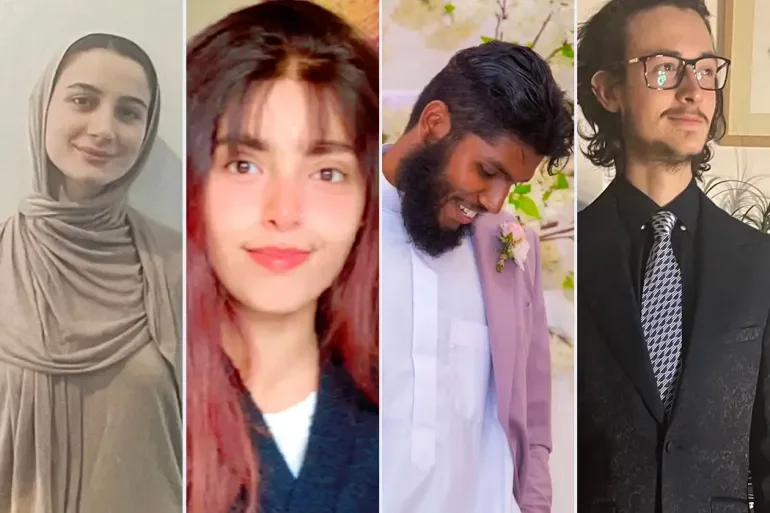
Palestine Action hunger strikers (left to right) Teuta Hoxha, Heba Muraisi, Kamran Ahmed and Lewie Chiaramello
Legally, Britain still protects freedom of expression under Article 10 of the Human Rights Act. But socially and institutionally, some speech clearly carries heavier consequences than other speech. That is the contradiction younger audiences increasingly notice.
The UK is also beginning to mirror America’s culture war approach to speech.
Under Donald Trump, debates around protest speech, media bias and “anti-Americanism” became central political battlegrounds. Universities saw police crackdowns on demonstrations, journalists were labelled enemies and protest movements became framed as national security concerns.
Britain is not America.
But the rhetoric is becoming dangerously familiar.
Protests are increasingly discussed through the language of extremism, disruption and public order rather than democratic participation. The Public Order Act expanded police powers around demonstrations and media discussions around Palestine often focus more heavily on protest risk than the humanitarian crisis itself.
None of this means Britain has abolished free speech but it does mean speech is increasingly managed according to perceived institutional risk.
What became obvious after speaking to both Enders and Choudry is that neither believes the BBC operates as a centrally coordinated propaganda machine. Both instead described an institution under enormous pressure: political pressure, legal pressure, social pressure and financial pressure.
But audiences increasingly do not care about those internal complexities. When broadcasters appear inconsistent, people assume motive. When political speech gets edited, people assume agenda. When institutions explain themselves using vague language like “editorial standards”, younger audiences hear bureaucracy protecting itself.
And perhaps that is the real crisis facing British media. Not censorship itself. But the collapse of public belief that powerful institutions apply their rules equally.