Scotland’s Missed Goals: How Inclusion Could Be Football’s Greatest Win
Inclusion, integrity, progressive. These are the words often used to highlight Scotland’s supposed moral distance from its southern neighbour, a nation priding itself on social conscience, from climate policy to public services. And yet, nowhere is this self-image more clearly contradicted than in Scottish football.
That this nation, so proud of egalitarian values, has failed so markedly to extend them to its national sport is more than ironic, it’s shameful. The first ethnic minority player to don the Scotland shirt was Andrew Watson in 1881. Over a century later, the list of successors remains painfully short. Che Adams and Nigel Quashie are often named as signs of progress, but neither was born or developed in Scotland. Their inclusion only highlights the problem, Scottish football isn’t producing these players through its own system, and often when there is an example the players are borrowed.
Consider this: across the top four divisions in Scotland, roughly 1,200 professional footballers are registered. Of those, Scoutable FC research indicates only seven or eight that progressed through the Scottish youth system come from ethnic minority backgrounds, a staggeringly low 0.6%. This figure is wildly out of sync with the demographics of modern Scotland, particularly in urban hubs like Glasgow and Edinburgh. Glasgow’s Pakistani community alone is four times larger than any other in the country. These are multicultural cities. Yet on the pitch, Scottish football remains monolithic.
The exclusion is not new. Historically, even Catholic players of Irish descent - despite being born and bred in Scotland - were sidelined. When Celtic’s all-Scottish Lisbon Lions won the European Cup in 1967, they earned just 113 international caps between them. Rangers’ Protestant stars from the same era - Greig, Baxter and Jardine - won more combined. Culture, not merit, defined opportunity. It goes without saying these three were some of the greatest players of their era and so the volume of appearances is not surprising, but the disparity in opportunity for the catholic stars of the same time is eye-opening, even if it’s not shocking.
The present isn’t much better. Denmark, with a similar population and ethnic breakdown, currently boasts nine national players from minority backgrounds. Scotland? Still clinging to tokenism. As Rob Webb described in Holyrood, there’s a “fit in or f*** off” mentality in Scottish football, both at grassroots and in boardrooms. For many young ethnic minority players, the dream of making it feels distant, not due to lack of talent, but lack of belonging.
That’s where people like Yusuf Bamba step in. As the founder of Scoutable FC, Bamba is doing the work that the SFA should have been doing years ago: creating a platform for talent that’s often overlooked.
“Scoutable has given a chance to players who’ve been overlooked by the system,” Bamba says. “These are talented young people who don’t always come through the usual routes, maybe because of where they’re from, who they know, or not having the right support system. We’ve created a space where their talent can actually be seen.”
Through showcase matches and trials, Scoutable has connected these players to real opportunities. But Bamba is under no illusions: grassroots change is not enough. “Real change needs to happen at a higher level, like the SFA or SPFL,” he explains. “In England, platforms like Scoutable get backing from the FA. In Scotland, we keep hearing ‘you’re doing a great job,’ but there’s no real help. Words don’t create change, support does.”
This lack of institutional buy-in isn’t limited to football’s governing bodies. Bamba recalls his attempts to secure sponsorship and media support with mixed success. “Some sponsors believed in what we were doing and were happy to contribute in the moment,” he says. “But when I pitched longer-term plans, it became more difficult. Even if they loved the idea in principle, they often pulled back with reasons why they couldn’t commit.”
As for media attention, Bamba acknowledges the exposure but questions the intent. “With the BBC, I felt the interest was driven by finding a story that fit their narrative at the time. I didn’t necessarily get the sense there was a long-term commitment to action.” He singles out broadcaster Jean Johansson as a rare exception, someone who followed up and genuinely tried to help. “Whether it was deeply heard or not, I can’t say,” Bamba adds, “but it hasn’t discouraged me. I’ll keep finding ways to make this issue heard.”
And the issue is continuously swept under the rug. Kevin Harper, who became the first black player to sign for Hibernian in the ’90s, speaking to Holyrood recalls racial abuse without institutional support . “That was 30 years ago,” he said. “But I don’t think we’ve moved that far forward.” Today, Marvin Bartley stands alone as the only black coach in the Scottish leagues. Meanwhile, two white managers have faced public accusations of racism. The arithmetic speaks volumes.
Worse still is the silence from those in power. When approached by Holyrood to comment on racism in the game, both the SFA and SPFL did not. The SFA offered a customary equality framework. The SPFL outsourced the inquiry to a PR firm. Neither engaged directly. Does this mean those institutions are turning a blind eye to racism altogether? I think at would be a harsh characterisation as there have been initiatives put in place over the last decade or so to improve the routes through which young Scottish footballers progress, and this would include players of all backgrounds. However the specific issue of underrepresented minority groups often feels like an after-thought, or in this case, not important enough to comment on. As Jordan Allison of Show Racism the Red Card put it: “If there are no people of colour at the decision-making table, how can these organisations understand the lived experiences of those they’re excluding?”
Scotland cannot expect to compete internationally while ignoring the full breadth of its talent. Inclusion isn’t just morally right—it’s strategic.
Our recent World Cup qualifying success may paper over the cracks and validate naysayers. Maybe.
However, one can only wonder that if Scottish football looked like Scotland itself, we wouldn’t have had to wait nearly three decades.
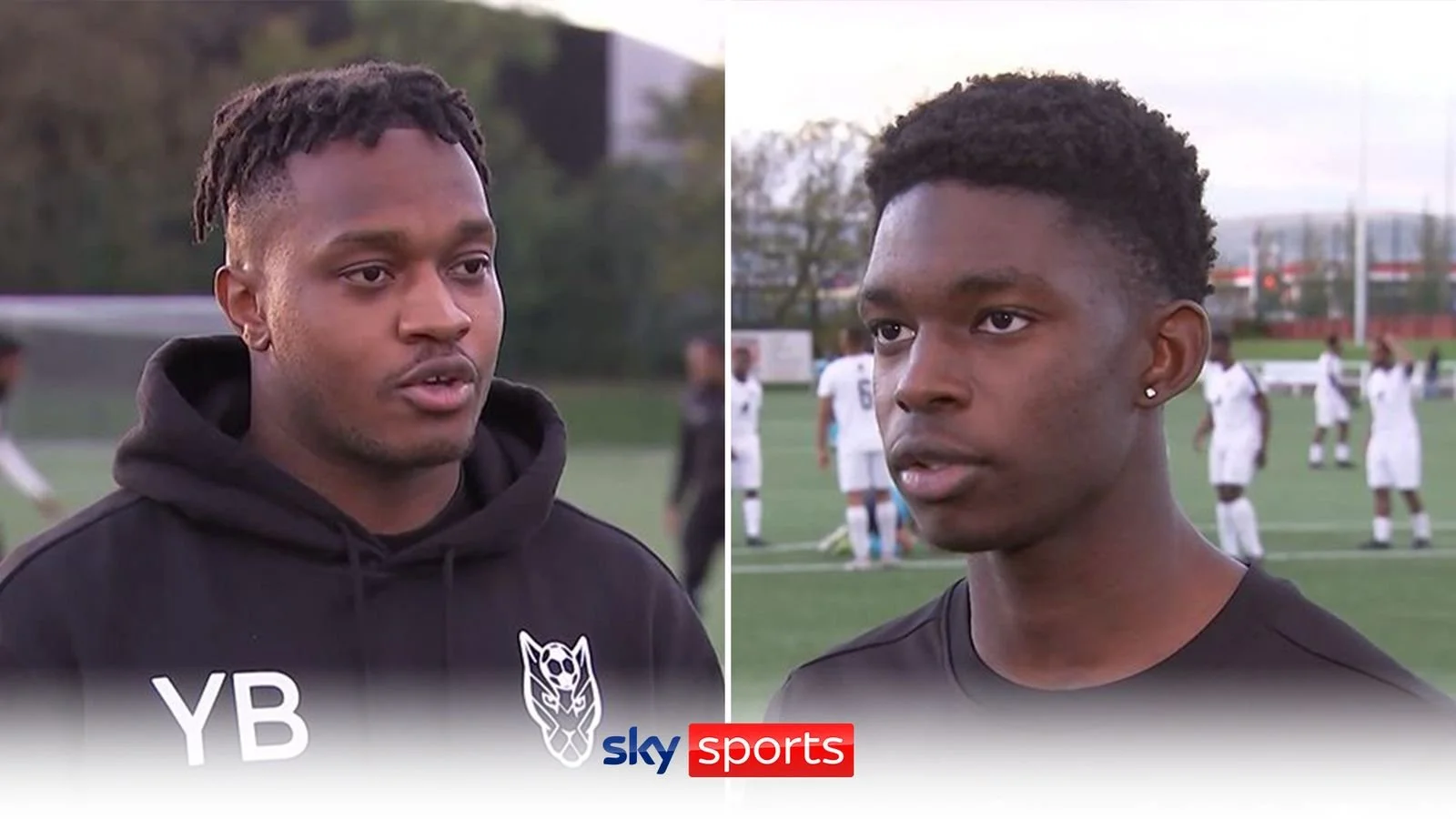
Yusuf Bamba and Scoutable FC player speaking to Sky Sports