Why is Islamophobia on the rise in the UK?
Islam has always been a misunderstood faith in the UK, and its followers have faced discrimination ever since the first Muslims migrated here 300 years ago from India. Although we like to believe that three decades of progress have helped us move toward understanding and integration, the reality for modern Muslims within the UK remains one of subliminal prejudice, inaccurate preconceptions, and, ultimately, fear.
This fear is not unfounded. The Home Office reports 3,866 religiously motivated hate crimes against Muslims in the year ending March 2024. This makes up 40% of all hate crimes of this kind, meaning Islam is the most affected religion by a large margin. Government reports on hate crime over the past five years show how disproportionate these crimes are toward the Muslim community. Muslims have topped the list each year, with the percentage steadily increasing.
Omar Afzal, Outreach and Communities Coordinator for Glasgow Central Mosque, describes the fear: "The fear is heightened, particularly after the riots in England, which vividly show the effects of Islamophobia rising. It shows how quickly Islamophobia can become violent, leaving Muslim communities living in fear. But since 9/11, there’s been a shift in how Islamophobia manifests. Before, someone might have insulted you based on your race, but now it’s more about your Muslimness. An Asian man with a long beard or a woman in a headscarf becomes an easy target. And women tend to be victims more often, probably because they’re more visibly Muslim."
The rise of Islamophobia after the 9/11 attacks didn’t happen in isolation. Western media, particularly networks like NBC and ABC, played a significant role in shaping public perception of Islam. Kimberly A. Powell, in Communication Studies, explains how these outlets, along with powerful governmental figures, framed the attacks as a war on America by Islam, presenting it as an existential threat. This portrayal linked an extreme act of terrorism to an entire religion, further solidifying the stereotype of Islam as a religion of terror.
The media’s biased use of the term “terrorism” also plays a role. When was the last time we heard the term used for a white American school shooter or someone like Greg McMichael, who killed a Black jogger in 2020? The term seems to apply only to attacks by non-white, Muslim individuals, while white perpetrators are often portrayed as troubled or mentally ill and attributed reason, highlighting a stark double standard.
Fast forward to today, and these framing methods persist. Charity Tell Mama documented a sharp rise in Islamophobia in the UK in the four months following the Hamas-led October 7th attack. This uptick coincided with coverage of the Israel-Palestine conflict, a connection hard to overlook, especially when considering the portrayals in British outlets like the BBC.
One such example involved Maccabi Tel Aviv fans travelling to Amsterdam for a football match. They ripped down Palestine flags, attacked locals, and spread anti-Islam hate. Yet, the BBC downplayed the incident, describing it as "Youths on scooters attack Tel Aviv fans" and emphasizing the need to combat anti-Semitism. This characterization, avoids acknowledging the full scale of Islamophobic behaviour present in such actions, underscoring how media framing can serve political or ideological goals.
Professor Tahir Abbas, a scholar on radicalization and Islamophobia at Leiden University, argues that Western media plays a significant role in shaping public discourse surrounding the Israel-Palestine conflict. He explains that "media coverage often perpetuates orientalist paradigms and colonial power relations" through selective framing of events. These biases are not just isolated to news reporting but reflect deeper institutional practices that stem from historical power dynamics, colonial legacies, and political-economic interests.
Abbas emphasizes that these biases aren’t simply the result of poor journalistic standards. They are embedded in the very structures of media institutions. "The concentration of media ownership and control," he notes, "reinforces dominant cultural narratives and systematically excludes diverse voices from decision-making positions." This leads to a self-reinforcing cycle where biased reporting continues to perpetuate prejudice, making it harder to challenge existing power structures that disadvantage Muslim communities.
So, what can be done to shift the narrative and reduce Islamophobia in the UK?
For Abbas, addressing the issue requires a comprehensive approach: "It’s about structural interventions at multiple levels. This includes robust hate crime legislation, media reform, and better diversity in public institutions. At the individual and community level, we need critical media literacy, inter-community dialogue, and support for grassroots Muslim organizations."
Omar Afzal adds that meaningful change also requires a legislative shift. "The government needs to improve reporting on how Islamophobia manifests in different sectors, and they need to adopt a formal definition of Islamophobia. Without acknowledging that a problem exists, you can't begin to strategize a solution." Afzal also points out that education plays a crucial role in challenging the narrative around Muslims in the UK. "We need to teach the true history of Muslims in this country—their contributions to science, medicine, and technology—and provide a counter-narrative to both the media and the far-right."
Afzal further emphasizes the importance of allyship in fighting Islamophobia: "As individuals, we need to call out hate crimes, support victims, and report incidents to the authorities. It’s also important to take the time to learn about the religion itself."
Media coverage will always influence public opinion, that much is clear, and the biases present in that coverage seep into broader societal dialogues. It’s crucial, therefore, that facts take precedence over feelings when it comes to representing Islam and Muslims. As Afzal concludes, "To create a fairer and less discriminatory environment, we must confront Islamophobia head-on and challenge the narratives that sustain it."
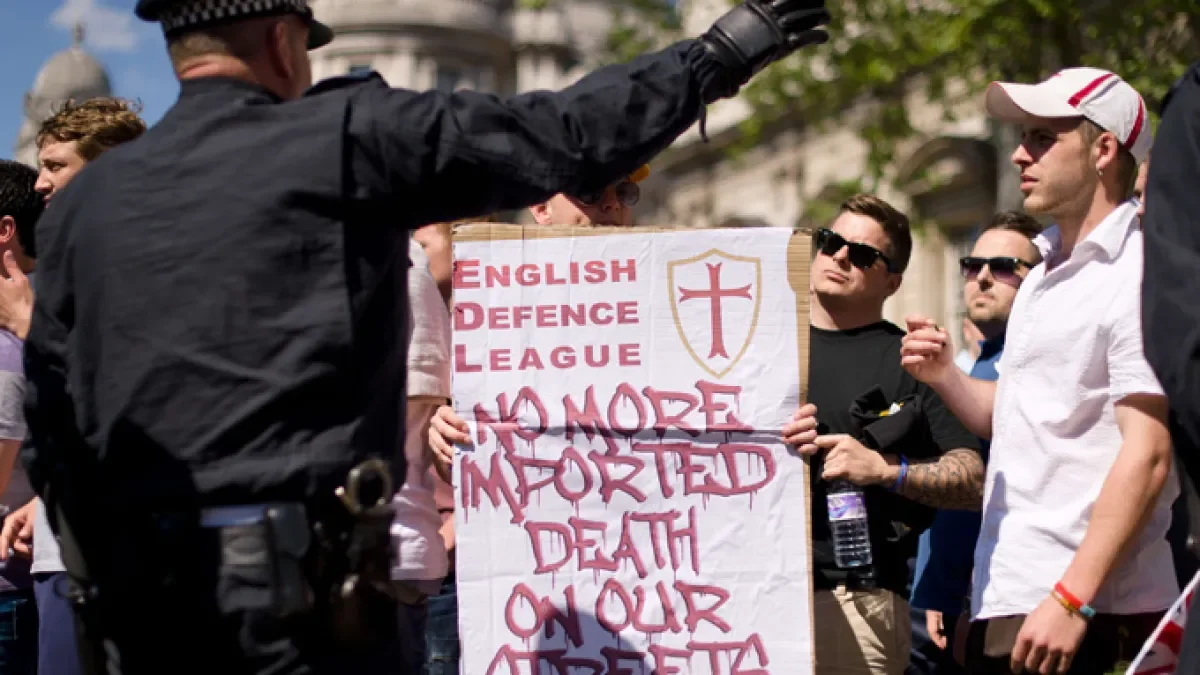
Anti-immigrant demonstration in England
Alfie Robinson