Scotland’s second-class sport
Basketball in Scotland has a strange double life. On paper, it is everywhere. It appears in council inclusion strategies, youth diversion programmes, and government-funded initiatives designed to improve wellbeing, participation, and community cohesion. It is regularly praised for its ability to reach young people who other sports struggle to engage, particularly in working-class and ethnic minority communities. In funding reports, it is framed as progressive, accessible, and socially valuable.
In real life, it survives on sacrifice.
I learned that not from policy documents but from watching my brother Louis try to make his way through the Scottish basketball system. While my own football career was cushioned, not free, but institutionally supported, basketball demanded constant personal subsidy. Long drives to training, juggling work around sessions, paying to play, paying to travel. Family money covered what the system didn’t. Time off work replaced paid development. Even representing Scotland or playing for the Glasgow Rocks came with little in the way of financial security.
It's the usual, rhetoric over commitment.
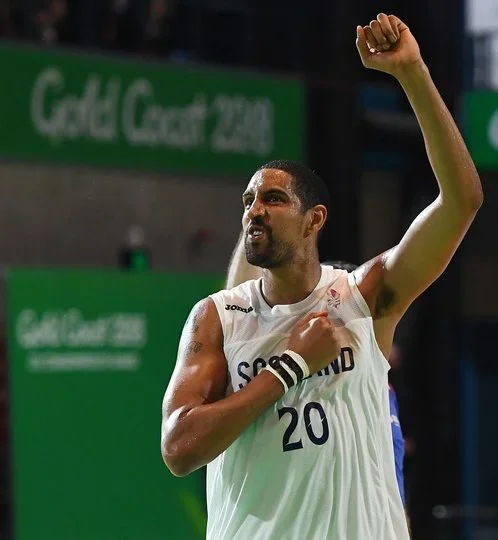
Kieron Achara representing Scotland at the Stirling Highland Games
Sportscotland, the national agency responsible for public investment in sport, distributes around £36.7 million annually across governing bodies and grassroots programmes. Within that framework, a hierarchy remains firmly intact. Football is treated as economic infrastructure, credited with contributing around £820 million a year to the Scottish economy and supporting more than 14,000 jobs. Rugby, too, enjoys political protection as a performance sport tied to national identity and prestige. Basketball, by contrast, is overwhelmingly funded through social programmes rather than sporting pathways.
Since 2008, CashBack for Communities has invested over £110 million into projects aimed at youth diversion and inclusion, with basketball a recurring beneficiary. Basketballscotland’s most visible public funding streams are routed through charitable arms and partners such as Inspiring Scotland, money tied to participation numbers, wellbeing outcomes, and community engagement. Important work, undoubtedly. But this is funding designed to manage social outcomes, not to build sustainable sporting careers.
Former Scotland and Great Britain basketball captain Kieron Achara had this to say speaking to BBC back in 2020:
“"I believe there are barriers. It's not just a race thing, it's about social status, low incomes and such like. If you look at sports clubs, you are paying your direct debit of £40 or £50 a month. Then parents have to drive their children to sessions because facilities aren't easily accessible.
"It's not the case that kids from the BAME community aren't interested in sport. Only once we get to the stage of understanding that barriers are there we can knock them down."
Louis felt the consequences of that early. “Most of it was self-funded,” he says. “Compared to other sports that were just as popular, there was very little funding. To play for a team you had to pay and pay for transport. And of course, the more you paid, the better the amenities. Teams with wealthier players had better facilities.”
Access, in other words, was classed.
That class filtering was reinforced culturally. “There was still a distinctly Glasgow community around basketball when I was coming through,” Louis explains, “probably a relic of when basketball was more popular. But it was always small. Football was the priority, and even other sports like badminton seemed to be taken more seriously.”
Basketball, he argues, occupies an awkward space in Scotland’s sporting imagination. “It’s a sport that lends itself really well to a working-class environment and thrives there. But in Scotland, that role is already taken by football. So basketball ends up either being niche, or pushed into more affluent suburbs, where it never really gets mass appeal.”
Achara speaking to BBC also commented on this:
"It's the more affluent people who are making it to the next level. You can see it in football, which used to be a working-class sport. There's been a culture shift there too.”
That contradiction plays out vividly in schools. Growing up in a predominantly white Catholic school in Scotstoun, basketball became a marker of identity for Louis. “It was mostly non-white students playing,” he says. “It definitely became something that unified a lot of ethnic minority students across year groups.”
That pattern repeats across Glasgow. Outdoor courts fill up every summer evening. Places like Mansfield are informal meeting points - open, mixed, and accessible. Louis points out something often overlooked in discussions about sport and space: “They’re gender diverse as well. Women feel comfortable playing and hanging out. With the right funding, that could be developed into an actual culture.”
Jason McCullogh has seen this firsthand for over a decade. A player, coach, and long-time advocate for better facilities in Glasgow, he has worked at grassroots and college level, often pushing simply for usable courts and affordable access.
“Basketball is really good for integration,” he says. “You walk onto an outdoor court and it doesn’t matter where you’re from, what you look like, what accent you’ve got. If you can play, you’re in, and half the time even if you can’t people teach you.”
He contrasts that openness with football’s cultural baggage in Scotland. “Football can come with sectarian stuff, territorial stuff, club loyalties. Basketball doesn’t really have that. It’s usually a neutral space. You end up respecting people based on effort rather than background.”
Despite that, basketball’s diversity has never translated into political leverage. The sport is praised for reaching working-class and ethnic minority communities yet remains marginal in decision-making spaces. Representation at board, council, and national level is limited and funding reflects that imbalance.
The idea that basketball is a meritocracy collapses quickly under scrutiny. “Making it to any real level of success out of Scotland is incredibly rare,” Louis says. “So, talent should be the main factor. But there were definitely biases when I played.”
6’11 big man Robert Archibald is still the only Scottish-born player to reach the perceived pinnacle of basketball, the NBA.
Most players at national league level in Glasgow were from ethnic minority backgrounds, he notes, and that shaped how they were treated. “By refs, by other coaches, by spectators, you felt it.” Money mattered too. “Some players could be sure of spots on teams because they brought funding with them.”
Talent loss, then, is not accidental. It is systemic.
Jason sees the same dynamic from the other side. “Basketball in this country is heavily reliant on unpaid labour and pure goodwill,” he says. “That tells you exactly where it sits in the pecking order.”
Coaches, referees, administrators, most are volunteers. Many pay out of their own pockets. “If that goodwill disappeared,” he adds, “a lot of these clubs just wouldn’t exist.”
This reliance has consequences. Burnout is common. Experienced coaches eventually step away because unpaid labour can’t compete with jobs, families, or basic survival. When they go, so does institutional memory, trust, and stability. “That’s years of experience gone,” Jason says. “Years of relationships with communities.”
The contrast with football is stark. Even at relatively low levels, football benefits from paid staff, secure facilities, and consistent funding. Basketball scrapes by on short-term grants and volunteer commitment.
Scottish sport policy prides itself on inclusion. Participation targets are highlighted. Press releases celebrate diversity. But accountability is thin.
“If councils and national bodies say basketball is part of their inclusion strategy,” Jason argues, “then they should be measured on outcomes. Retention in deprived areas. Diversity in coaching and leadership. Long-term funding commitments.”
Instead, inclusion often functions as branding. Basketball is useful to the state because it does heavy social lifting cheaply. It keeps young people active. It builds informal integration. It creates community space. But when it comes time to invest materially - courts, paid roles, elite pathways - the commitment evaporates.
That contradiction mirrors a wider Scottish habit: comfort with progressive language, discomfort with redistributive action. Scotland likes the idea of fairness more than the practice of it.
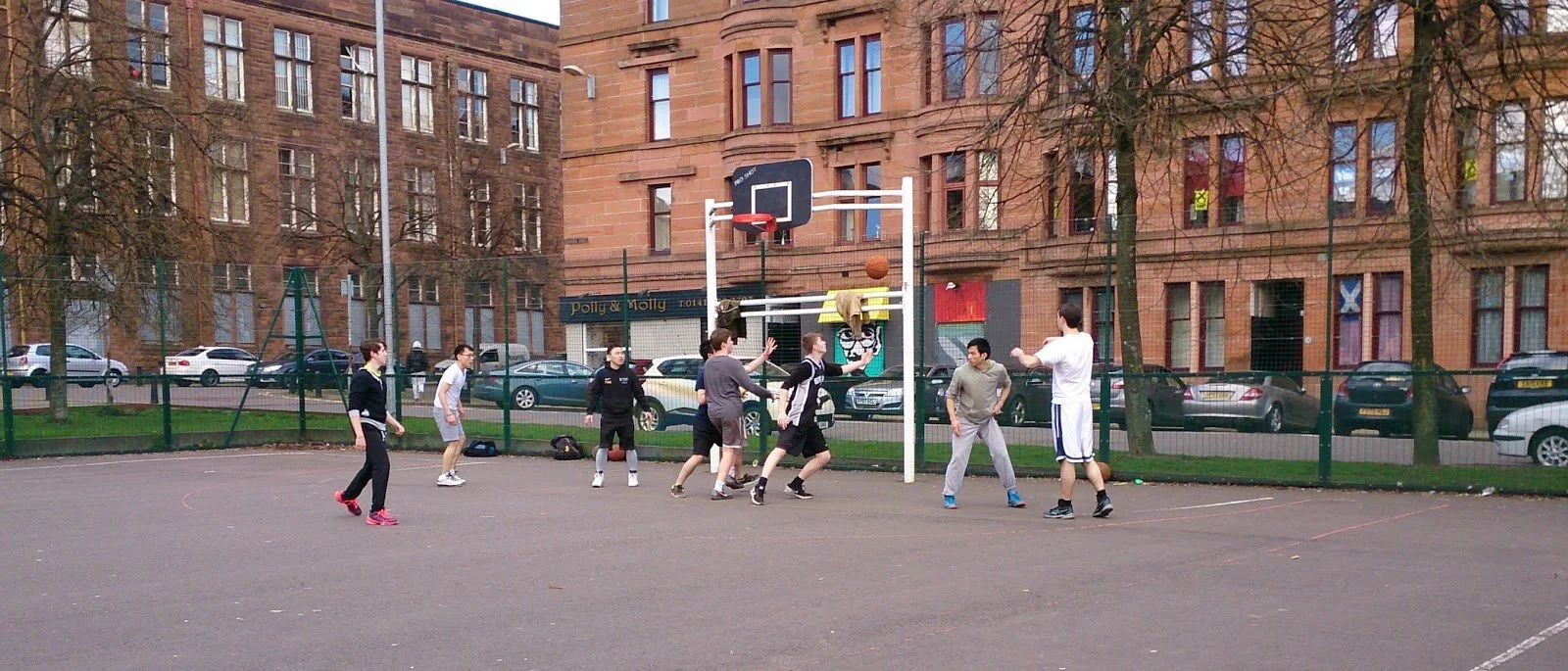
pickup game at Mansfield Park, Glasgow
Basketball is not asking to replace football. It is asking to be taken seriously. The appetite is visible on outdoor courts every summer. The diversity is real. The social value is proven. What’s missing is political will.
“If Scotland genuinely believes the stories it tells about itself,” Jason says, “basketball is a perfect test case. The game already brings people together naturally. All that’s missing is the will to put something back into it.”
Until then, the consequences are predictable: unpaid labour, filtered access, lost talent, and stalled futures. Basketball will continue to be praised, underfunded, and quietly neglected while headlining as a marker for diversity in our country. Ironic? I suppose, but irony is often lost on people representing a system that survives on posturing.